
30 October 2026


Reading time [minutes]: 19


Distributed Diagnostics

Distributed PCR: access to diagnosis and care

How to assess local diagnostic services, from patient waiting times to continuity of care.


Abstract

Organising some PCR tests at peripheral sites requires trained staff and an operational link with reference laboratories. WHO recommends strengthening diagnostics through networks integrated into health services [1,2]. This Insight examines how to assess their social impact: access to testing, care after the result and the costs borne by households. Tuberculosis data describe difficulties that remain substantial. Methodological guidance helps establish local assessments, distinguishing service performance from health effects. Reductions in mortality or savings attributable to a particular organisational model require specific evidence.

Snapshot

Access. Identify the people the service is intended for and the difficulties they face in using it.

Results and care. Check whether the report reaches those who must decide how to continue care.

Expenditure. Keep healthcare facility budgets separate from the costs borne by households.

Inequalities. Compare service use across geographical areas and population groups.

Introduction

For someone living far from a laboratory, a test may entail a journey and a lost day's work. Even when the sample is collected close to home, it may need to reach a distant centre. This is why the Global Fund's work on laboratory networks includes sample transport and the communication of results [2].

In this article, distributed PCR means performing molecular tests at multiple sites connected to reference laboratories. To assess it, we follow the person's pathway from the test request to subsequent care: where waiting occurs, who receives the report and how any further investigations at another centre are organised.

1. Difficulties begin before sample collection

In its presentation of the Global Diagnostics Coalition, the World Health Organization (WHO) identifies around 4.7 billion people without access to safe, affordable and quality-assured diagnostic services. The estimate concerns diagnostics as a whole and helps frame the scale of the problem; it does not measure the benefit achievable by distributing a particular technology [3].

Distance is one of the difficulties to consider. Working conditions and income can limit people's ability to seek care, as WHO notes in its fact sheet on the social determinants of health [4]. When assessing a local service, this also means asking whether opening hours fit people's lives. Someone who depends on an accompanying person, for example, must be able to coordinate both people's availability with the appointment.

To assess the programme's equity, it is necessary to know whether the new sites also reach communities that have so far used the service less [4].

Before counting the tests performed, the population the programme is intended for must be defined. Difficulties reported by staff and service users can then guide specific changes, such as adjusting opening hours or arranging referral to another centre. Resolution WHA76.5 calls on countries to integrate diagnostics into health services and improve access [1]. Locally, it is necessary to assess which barriers the programme actually removes and which continue to prevent people from receiving care.

2. Choosing where to perform the test

The nearest site must be able to sustain the planned work. The Global Fund describes networks that connect local services and laboratories through sample transport, information systems and quality management [2].

Local planning can therefore compare performing the analysis on site with establishing a more reliable connection to the reference centre. If the delay is concentrated in the days before the sample leaves, for example, more frequent transport also deserves consideration. If the report is instead waiting to be communicated, that step needs attention. The choice must start from the times actually observed in the service.

Samples impose specific requirements. In WHO training materials, sample management begins with collection and includes identification and storage. The laboratory must have criteria for accepting the material received and record problems that require a new sample to be collected [5]. For a peripheral site, these checks are part of daily work even when the instrument automates the analysis.

Resource availability must also be checked before installation. The WHO module on equipment considers the instrument's compatibility with the service and the condition of the premises, together with the support available. It provides for operator training and performance verification before use on patient samples [6]. This methodological guidance helps organise the laboratory; it does not replace checking the test's intended use and the applicable requirements [1].

3. What tuberculosis data show

Tuberculosis makes it possible to observe the gap between estimated need and recorded diagnoses. The WHO 2025 report estimates 10.7 million new episodes of disease in 2024. In the same year, around 8.3 million people with a new episode had been diagnosed and notified to the authorities; the count also includes relapses [7,8]. The difference reflects both missed diagnoses and shortcomings in reporting. It therefore does not correspond to a definite number of people who have never been tested [8].

Among these notified cases, 54% had initially received a WHO-recommended rapid diagnostic test, compared with 48% in 2023. Only eight of the thirty high tuberculosis burden countries reported that these tests were accessible at more than half of diagnostic sites. The category used in the report is recommended rapid tests: the figure must not be attributed indiscriminately to any PCR test [9].

This information measures coverage and use. The clinical effects of a different organisational model require a specific comparison.

Local assessment must also follow what happens after diagnosis. A valid result received by the doctor can guide care in the context intended for that test; treatment decisions and any further investigations remain clinical responsibilities. Dedicated assessments are needed to support a claim that a reorganisation reduces mortality or transmission. The access statistics just cited do not measure these effects [9].

4. Keeping the service available over time

The person responsible for a network must know what happens when a site stops operating. The WHO module on equipment provides for documented maintenance, fault identification and alternatives during repairs, including sending samples to another laboratory [6]. The operational plan must therefore specify who takes responsibility for the problem and how the service awaiting the result is informed.

Supplies also require ongoing planning. PAMTA, the initiative launched in July 2025 by the European Commission and Africa CDC, supports mpox testing and sequencing in Africa. The programme includes training and support for the local production and validation of mpox kits [10]. Its scope is specific. The launch announcement presents objectives and activities, while the effects on access to care will need to be assessed.

During an interruption, the availability of an alternative centre can change what happens to the patient. Transport times and that laboratory's availability must therefore be included in the plan to maintain the service. Records should show which requests were handled elsewhere and which remained pending [2,6].

5. Which costs to compare

An economic evaluation begins by stating who bears the costs. A healthcare facility's budget and a household's budget answer different questions. CHEERS 2022 requires the perspective adopted, the comparator and the time horizon to be made explicit, together with the methods used to value resources and outcomes [11].

For the facility, the assessment includes the purchase or use of the instrument and staff costs. Training and maintenance must also be considered, along with the materials needed to perform tests. Contractual terms and the availability of support can change expenditure over time [6]. The comparison must use consistent criteria for the organisational models examined and state the assumptions adopted [11].

For households, costs extend to travel and income lost during care. The WHO 2025 tuberculosis report brings together forty national surveys completed between 2015 and August 2025, with data on costs throughout the entire episode of disease. The pooled proportion of people treated and their households facing costs defined as 'catastrophic' was 47%, with a 95% confidence interval from 37% to 58%. The average is weighted according to each country's share of notified cases [12].

In these surveys, costs are defined as catastrophic when they exceed 20% of annual household income or expenditure. The total includes medical expenses, other care-related expenses and income losses [12].

These data measure financial difficulties throughout the entire tuberculosis episode; they do not estimate the savings achievable with a PCR test performed close to home [12]. When comparing services, the outcome against which expenditure is assessed must be clear. Cost per test performed and cost per person receiving a valid result answer different questions. The reference measure may change, but the perspective must remain explicit: moving from laboratory expenditure alone to overall societal costs requires a separate comparison. CHEERS helps make reporting transparent; it does not certify the quality of the method or whether the intervention offers value for money [11].

6. Getting the result to those caring for the patient

Those caring for the patient must receive the result in time to use it. The WHO module on information management requires the report to reach the correct recipient and arrangements to be established for communicating urgent results [13].

The information system can link the sample, analysis and report, making it possible to check when the work was completed and the result sent. The project must provide for backups and the protection of confidentiality, with access assigned according to responsibilities [13]. A network with multiple sites also needs a procedure for failed communications: who checks them, who contacts the recipient and how recovery of the information is recorded.

Consider a simple case: the analysis is complete, but the doctor who requested it does not receive the result. The time saved during testing remains unused until someone recognises the problem and restores communication.

7. Assessing who benefits from the new organisation

An increase in the number of procedures performed may be concentrated at sites that are already more widely used. To interpret it, it is useful to compare access across groups and geographical areas, taking account of social conditions that may hinder care [4]. For tuberculosis, WHO also highlights the role of social protection in reducing the burden of costs and supporting continuity of care [12].

A local assessment can start with the people the programme is intended for and follow where care is interrupted. Does the new service reach those who previously gave up on making the journey? Can those who need to complete investigations at another site do so? The answers require locally collected information and discussion with staff. Personal data must be protected, avoiding the collection of details that are unnecessary for the assessment [13].

A reduction in waiting times observed only at urban sites, for example, would not demonstrate an equivalent improvement in remote areas. The comparison should also include areas where the service is little used and the reasons for non-participation [4].

8. Before extending the project to other sites

The conditions of a pilot project must be documented. If dedicated staff or exceptional technical support are provided, the assessment must clarify how they will be sustained subsequently. The WHO module on process improvement proposes defining indicators, acceptable limits and the actions to take when a problem emerges in advance [14].

For a distributed network, this criterion can be applied to rejected samples and analyses that need to be repeated. Times must be measured with stated boundaries: from collection to result, or from request to communication to the doctor. When the programme includes the subsequent start of treatment, that step needs its own measure. Separate records make it possible to distinguish, for example, a delay in analysis from a wait for the next consultation.

Health outcomes require further assessment. The WHO material notes that they also depend on the patient's condition and the stage of disease, as well as diagnosis and treatment [14]. If the project changes staffing and organisation at the same time, a change observed before and after the intervention cannot, on its own, isolate the effect of the test.

The project coordinator must also examine what went wrong. An increase in requests may leave routine activities uncovered; a site may need support more frequently than expected. These observations help establish where expansion is sustainable and where additional resources are needed. Resolution WHA76.5 calls for the integration of diagnostics into health services, with adequate staff and infrastructure [1].
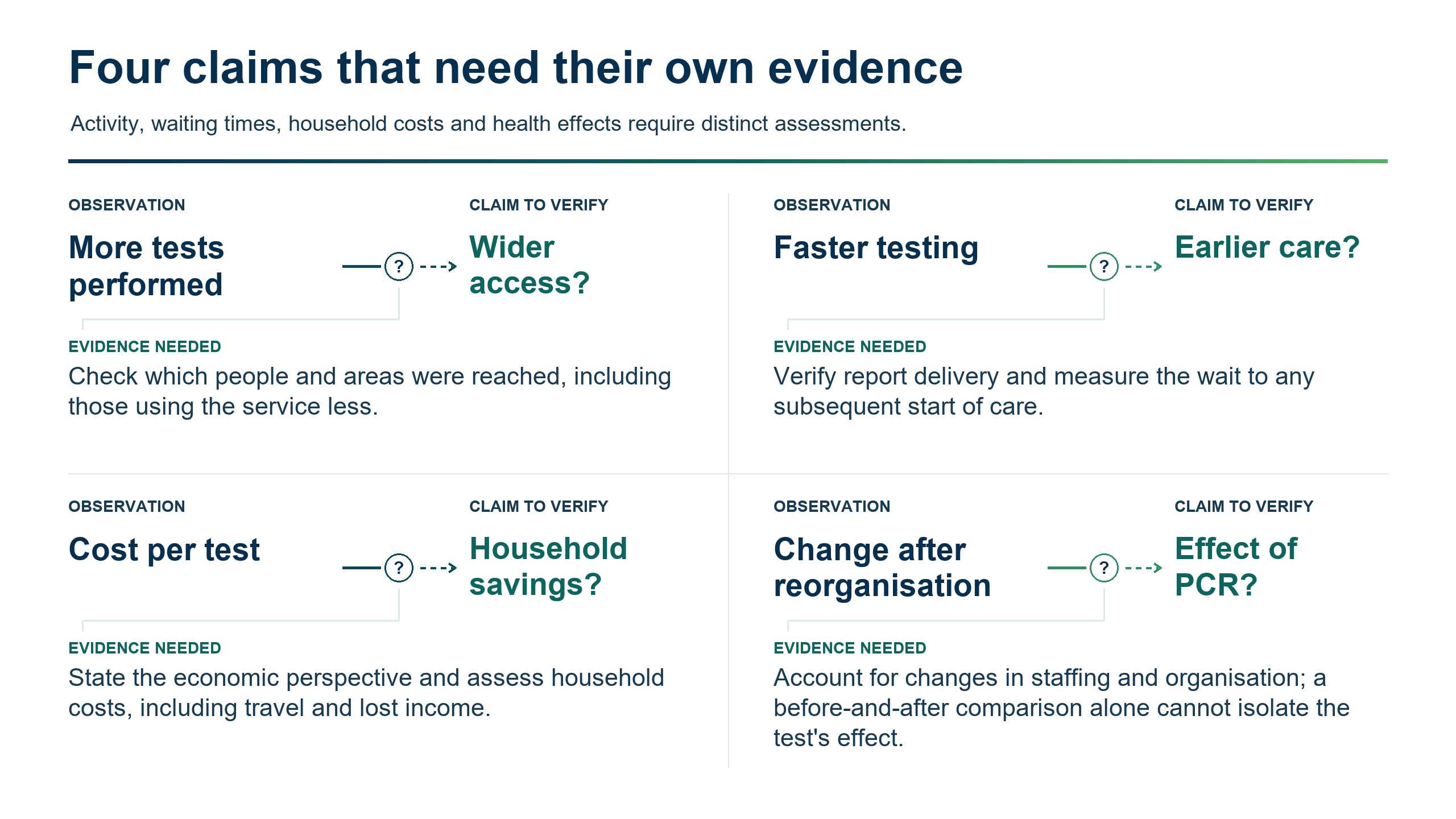
Four distinct checks: more tests do not establish greater equity; test times do not measure subsequent waits; cost per test does not measure household savings; a before-and-after comparison alone does not isolate the effect of PCR.

FAQ

Can distributed PCR reduce patient travel?

It can do so when the test can be performed at the local site and the result can be used within the intended care pathway. Any travel for further investigations or treatment must be considered separately in the assessment [2].

What do the tuberculosis data cited in the article demonstrate?

They describe recorded diagnoses, access to recommended rapid tests and costs borne by households. They are neither a clinical comparison between platforms nor proof of the benefits of any PCR network [8,9,12].

How should costs be compared correctly?

State the alternatives, who bears the costs and the period considered. The economic perspective must remain explicit even when comparing costs per test and costs per result obtained [11].

How can it be checked whether the programme reaches underserved people?

Compare geographical areas and population groups, including the difficulties faced by those who make little use of the service. The total number of tests must be considered alongside the conditions of access [4].

What is the role of the reference laboratory?

It can support sites, perform analyses requiring specialist resources and receive samples when a local centre is not operating. Responsibilities must be defined within the network's organisation [2,6].

When is it reasonable to extend a pilot project?

When the planned checks show that the new sites can sustain the service with the available resources. Acceptance criteria and arrangements for handling problems must be agreed before the assessment [14].

Conclusions

Distributed PCR must be assessed within the service in which it is introduced. For people, what matters is the ability to obtain the test and what happens after the result. Continuity of supplies and the connection with those providing care remain part of organisational responsibility [1,2].

Tuberculosis data reveal diagnostic and economic difficulties that remain substantial. To decide where to distribute new activities, a local programme must document who manages to use the service and which waiting times change, also following those who encounter barriers after testing. This information helps justify the choice to strengthen a peripheral site or improve its connection with the central laboratory.


Sources

References accessed on 26 October 2026. The links open the full text of the cited resource. WHO training modules are used for basic methodological principles, not as an update on regulatory requirements.

[1] World Health Assembly. Strengthening diagnostics capacity. Resolution WHA76.5. 30 May 2023. Full text

[2] The Global Fund. Laboratory Systems Strengthening. 25 February 2025. Full text

[3] World Health Organization. Global Diagnostics Coalition. Institutional webpage. Full text

[4] World Health Organization. Social determinants of health. 6 May 2025. Full text

[5] World Health Organization; Centers for Disease Control and Prevention; Clinical and Laboratory Standards Institute. Laboratory Quality Management System training toolkit. Module 5: Sample Management — Content Sheet. n.d. Full text

[6] World Health Organization; Centers for Disease Control and Prevention; Clinical and Laboratory Standards Institute. Laboratory Quality Management System training toolkit. Module 3: Equipment — Content Sheet. n.d. Full text

[7] World Health Organization. Global tuberculosis report 2025. Section 1.1: TB incidence. 2025. Full text

[8] World Health Organization. Global tuberculosis report 2025. Section 2.1: Case notifications. 2025. Full text

[9] World Health Organization. Global tuberculosis report 2025. Section 2.2: Diagnostic testing. 2025. Full text

[10] European Commission — Health Emergency Preparedness and Response Authority. Strengthening health resilience: new initiative for mpox testing and sequencing in Africa launched. 30 July 2025. Full text

[11] Husereau D, Drummond M, Augustovski F, et al.; CHEERS 2022 ISPOR Good Research Practices Task Force. Consolidated Health Economic Evaluation Reporting Standards 2022 (CHEERS 2022) statement: updated reporting guidance for health economic evaluations. BMC Medicine. 2022;20:23. DOI: 10.1186/s12916-021-02204-0. Full text

[12] World Health Organization. Global tuberculosis report 2025. Section 5.2: Costs faced by TB-affected households, social protection and human rights. 2025. Full text

[13] World Health Organization; Centers for Disease Control and Prevention; Clinical and Laboratory Standards Institute. Laboratory Quality Management System training toolkit. Module 17: Information Management — Content Sheet. n.d. Full text

[14] World Health Organization; Centers for Disease Control and Prevention; Clinical and Laboratory Standards Institute. Laboratory Quality Management System training toolkit. Module 15: Process Improvement — Content Sheet. n.d. Full text