20 August 2026


Reading time [minutes]: 18


Biotech and Diagnostics Innovation

Portable PCR: when can the laboratory truly move?

The instrument is the visible part of a system that includes the sample, operator, biosafety, power, data and decision-making.


Abstract

Miniaturising the thermocycler takes PCR beyond the central laboratory; however, it is not enough to transfer diagnostic capability. At the point of use, sample preparation, contamination control, reagents, skills, power supply, connectivity, waste disposal and interpretation must all work together. It is the entire workflow, embedded within a network, that is portable. Clinical and surveillance studies document the feasibility of compact systems in selected scenarios while, at the same time, limiting their performance and usefulness to the matrix, assay, operators, environmental conditions and intended purpose. Clinical or operational value may emerge when the result arrives in time for a documented action, without shifting to the periphery risks that the system is unable to manage.

Snapshot

Workflow portability
The ability to perform the entire chain, from the sample to a usable result, within predefined acceptance criteria, in the intended context and with the intended operators.

Operational dependency
Infrastructure, consumable, expertise or step required for the test. Portability increases when a dependency is genuinely removed or managed, not when it is merely shifted or concealed.

Field feasibility
Evidence that a specific combination of platform, assay, matrix, operators and conditions can work in the scenario studied; it does not automatically equate to clinical validation or transferability to other uses [4,5,9].

Intended purpose
The stated use of the device or assay, including the intended users, samples, context and decision. It is this scope, rather than the compactness of the hardware, that determines the applicable category of use [10].

Expansion gate
Criteria established before the pilot to decide whether to proceed, stop or redesign on the basis of diagnostic performance, operational continuity and human factors.

Introduction

A thermocycler can be small enough to travel and still depend on a substantial part of the laboratory. Portability therefore becomes a systems question: what happens to the sample, which controls remain necessary, how the operator and environment are protected, and how the result reaches the decision for which the test was performed.

This Insight examines the transition from hardware to the complete workflow. It traces pre-analytical, environmental, digital and organisational dependencies; distinguishes clinical diagnosis, surveillance and near-patient testing; and finally translates the concept of portability into verifiable criteria for a pilot. The objective is not to establish that a platform is portable in absolute terms, but to define when a specific configuration may be considered reliable for its intended use.

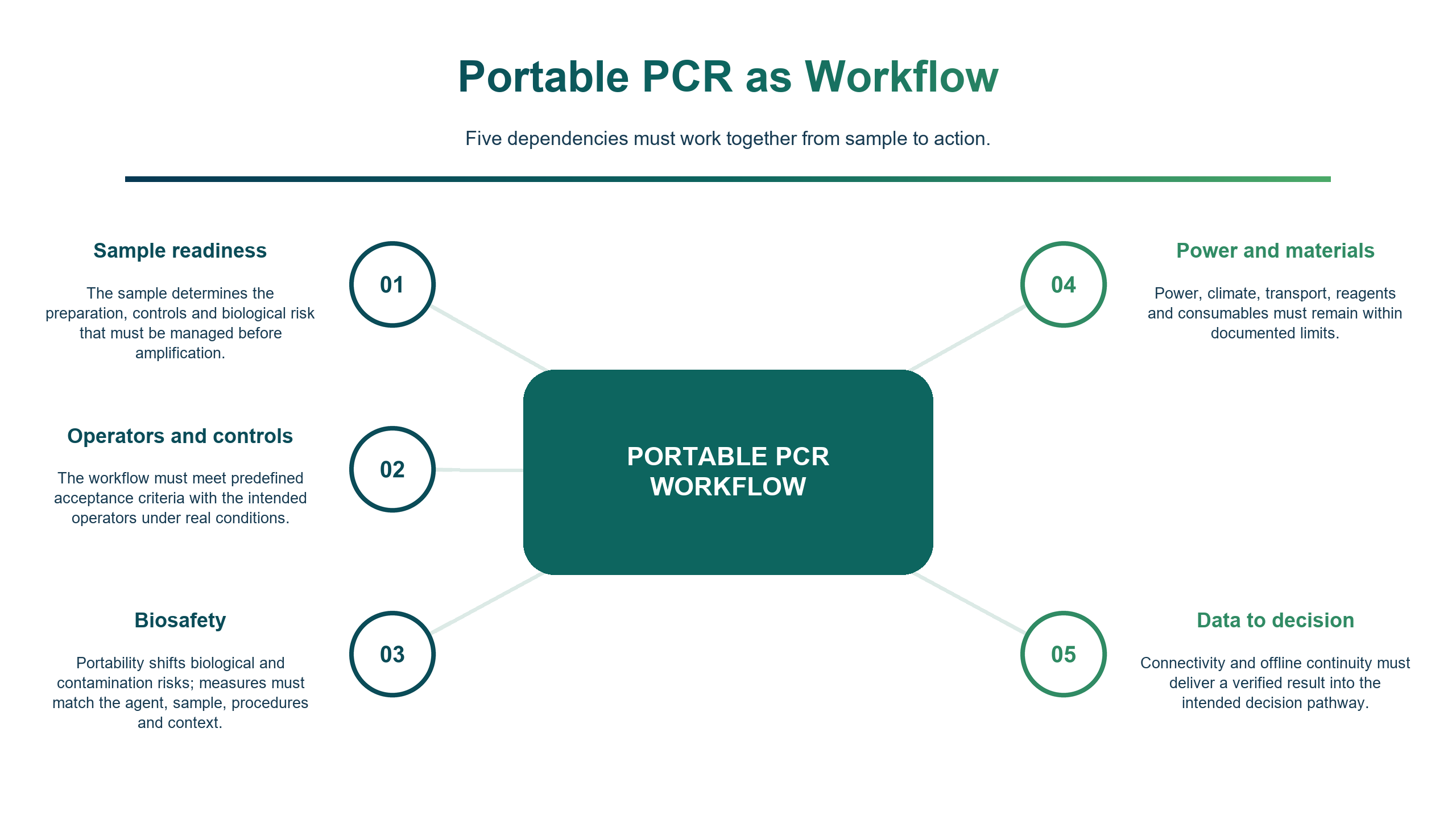
Hub-and-spoke map of the portable PCR workflow, surrounded by five connected dependencies: sample, operators and controls, biosafety, power and materials, and data to decision.

1. A suitcase is not enough to move the laboratory

Reducing size and weight does not eliminate what surrounds amplification. Biological material must be collected, identified, made safe and converted into an input compatible with the reaction. The result, in turn, must be checked, interpreted, linked to the correct person or sample, and communicated to those able to act.

To assess portability, hardware dimensions reveal little. Instead, the chain of dependencies must be mapped: centrifuge, biosafety cabinet, pipettes, extraction, refrigerator, connectivity, personal protective equipment, waste, maintenance and expertise. When a dependency is genuinely removed, the workflow moves closer to the point of use; if it is merely concealed, it will reappear during deployment.

The decisive test is different: does the workflow maintain performance within predefined acceptance criteria, in the real context and conditions, with the intended operators?

2. Diagnostic access: the problem that portability seeks to solve

The Lancet Commission on Diagnostics estimated that 47% of the world's population has limited or no access to essential diagnostics; access to even the simplest tests is particularly limited in primary care in low- and lower-middle-income countries [1]. Distance from the laboratory is only one component of the gap; the availability of staff, the supply chain, quality, funding and the ability to link diagnosis and treatment also matter.

Portable technology can shorten this distance, avoiding the need for a sample to travel for hours or days and bringing a molecular method into mobile campaigns, peripheral facilities or field investigations. Sustainable access, however, also requires reagents, maintenance and a care pathway. If these elements are missing, a donated device increases inventory without necessarily increasing diagnoses.

The REASSURED framework extended the classic criteria for tests intended for resource-limited settings by including, among other features, real-time connectivity and ease of specimen collection [2]. From this perspective, access means that the system can collect, analyse and return information in a usable form; where the instrument is placed is only one part of the problem.

3. The sample determines how portable the device is

PCR may be analytically robust and still fail before amplification. Sputum, whole blood, a respiratory swab, tissue, water or mosquito pools require different preparation and controls. Inhibitors, volume, storage and biological risk alter the workflow.

A sample-in, result-out system reduces manual steps and may limit variability and contamination, potentially at the cost of more complex cartridges, higher costs and dependence on proprietary consumables. Open systems offer flexibility but require expertise and more controlled conditions. The choice must be related to the intended use: the same architecture is not the most portable in every context.

MIQE 2.0 identifies sample handling, assay design and optimisation, controls, data analysis and transparent reporting as essential components of qPCR reproducibility [3]. It is a guideline for scientific practice and reporting, not a standalone standard for clinical validation. In portable deployment, however, it makes clear what must be documented before attributing the result to the instrument alone.

Feasibility studies show how strongly the sample affects portability. When developing an RT-qPCR assay for the surveillance of animal carcasses exposed to Ebola virus, the authors evaluated syringe-based extraction, portable reagents and equipment, as well as swabs stored under simulated environmental conditions for Central and West Africa [4]. This was not a clinical validation in patients. In Burkina Faso, an investigational direct-on-blood method was evaluated in 438 febrile patients: using qPCR as the reference, it showed 96.5% sensitivity and 98.0% specificity [5]. The finding belongs to that test, that population and that study design; integration into routine practice and scalability remain separate questions.

4. Biosafety and contamination travel with the test

Taking amplification beyond the central laboratory also shifts biological and contamination risks. The WHO Laboratory Biosafety Manual adopts a risk- and evidence-based approach: measures, equipment and practices must be proportionate to the agent, sample, procedures and context [6].

In open workflows, and whenever amplification products are handled, physical or functional separation, unidirectional flows, dedicated surfaces and decontamination become central. Closed systems can reduce openings and transfers, but they do not eliminate pre-analytical risks, misidentification, spills or waste management.

Operator protection must be calibrated to the sample: an inactivated swab, potentially infectious sputum and environmental material have different profiles. Minimum conditions do not disappear with portability. The target product profile and instructions for use must specify who may perform the test and which conditions are required.

The more mature design reduces openings, transfers and steps involving amplicons, integrates controls and defines how to manage spills, invalid results, exposures and waste. If these procedures are not realistic at the site, the sample must continue to travel.

5. Power, climate and materials: the field is an analytical condition

The presence of a power socket does not indicate whether the voltage is stable; a battery's stated autonomy does not indicate how many sessions it will support at high temperature. Instruments and consumables must also withstand dust, humidity, vibration and transport. Deployment must therefore be verified under representative conditions: environmental limits, start-up times, autonomy, protection and recovery after an interruption, each with defined acceptance criteria.

Lyophilised or stabilised reagents can reduce dependence on refrigeration, but stability must be stated in relation to temperature, humidity, packaging, shelf life and conditions after opening. Samples, controls or other components may retain different requirements. An ambient-stable supply chain is a documented configuration, not an automatic synonym for the absence of a cold chain.

The same applies to consumables. A test may be technically portable yet operationally halted by an unavailable tip, filter, control or cartridge. The deployment bill of materials must include everything that is consumed, everything that can break and the time needed to restore it.

6. The result must reach the decision

Connectivity helps keep the peripheral site within a network and supports patient identity management, result transfer, audits, supervision, surveillance and assistance. Because the network may be absent or unstable, the system must also specify what works offline, how it prevents duplication and how it synchronises data when connectivity is restored.

For clinical use, the result must enter the correct pathway. A positive tuberculosis result gains value if it triggers the required investigations, notification and treatment. The 2025 WHO guidelines consolidate recommendations for diagnostic technology classes and refer to an operational handbook for implementation [7].

The cluster-randomised TB-CAPT CORE trial evaluated 29 primary care facilities in Mozambique and Tanzania. The intervention combined on-site Truenat molecular testing, rapid communication and process optimisation. Among confirmed tuberculosis cases, 96.7% at intervention sites initiated treatment within seven days, compared with 63.3% under standard of care; same-day initiation was 82.2% compared with 3.3% [8]. The result belongs to the entire package and the context studied, not to hardware portability in the abstract.

The number of completed tests is therefore an insufficient metric. Useful metrics link timestamps and action: how many verified results are communicated and translated into the intended step within the target time? The appropriateness of the decision remains tied to the clinical protocol, the confirmations required and the quality of the evidence.

7. Two use cases that must not be confused

Portable PCR can support clinical diagnosis or environmental, veterinary and entomological surveillance. The two uses may share technology and a network, but they do not automatically share requirements, responsibilities or the meaning of the result.

In 2025, a study evaluated a configuration based on the Hyris System™ (bCUBE™) to detect Plasmodium species in experimental material and mosquitoes. The R² = 0.993 correlation with benchtop qPCR resulted from a comparison using serial DNA dilutions, not from the field pilot. In the preliminary pilot in Cameroon, 26 field-collected mosquitoes were processed on site—identification, DNA isolation, qPCR and analysis—in 4–5 hours; the same extracts were then compared with benchtop qPCR in the laboratory [9].

This is public, product-specific evidence of feasibility for entomological surveillance. It is not a clinical validation in patients, does not demonstrate performance for other assays or matrices, and does not automatically transfer a different intended purpose to the platform. Precision about the scope does not weaken the example: it clarifies which part of the workflow was actually tested.

8. Portability and near-patient testing are not synonymous

A portable thermocycler may be used by laboratory staff in a mobile facility, peripheral laboratory or field research setting. Under the IVDR, a device for near-patient testing is a device that is not intended for self-testing, is intended for use outside a laboratory environment and is generally used near to the patient by a healthcare professional [10]. The category derives from the stated intended purpose, user and context, not from size.

ISO 15189:2022 specifies requirements for quality and competence in medical laboratories and is also applicable to point-of-care testing as a general category [11]. It does not, on its own, define the regulatory status of a device and does not automatically assign a near-patient intended purpose to a platform or assay cited in the article.

A network can retain central supervision, operator authorisation, traceability of lots and controls, cross-site comparison and event review. Portability works when it distributes execution without fragmenting responsibility.

9. Designing a pilot that can fail usefully

A credible pilot places the workflow under the conditions in which it will be used: operators who are not selected only from among the most experienced, difficult working hours, intermittent connectivity, and realistic temperatures and volumes. The protocol must also include problematic samples, invalid results, downtime and escalation procedures.

Metrics must be separated. At the diagnostic level: performance against the reference and predefined criteria, invalid results, repeats, and management of discordant results by matrix and site. At the operational level: hands-on time, TAT to action, availability, consumption and recovery. At the human level: identification errors, training duration, maintenance of competence and workarounds. Every unplanned step invented by operators signals design friction.

The scope of the pilot must be stated: clinical use, surveillance, research or operational evaluation. A pilot does not replace performance evaluation or the applicable regulatory obligations. The expansion gate should not depend on accuracy alone; criteria for proceeding, stopping and redesigning must be defined before the pilot begins.

FAQ

Is a compact PCR device automatically intended for near-patient testing?

No. Its use depends on the intended purpose, location, operators and connection to clinical decision-making. A portable instrument may also be used for surveillance, field research or in a mobile laboratory [9-11].

Is cloud connectivity essential?

It is useful for traceability and supervision, but the system must have a safe mode for absent or unstable connectivity. Offline continuity is part of deployment.

Does portable PCR eliminate sample transport?

It can reduce it for workflows verified at the site. Complex samples, confirmations, sequencing and uncertain cases may continue to require the reference laboratory.

Does a field study automatically validate every assay compatible with the same platform?

No. The evidence belongs to the combination of assay, matrix, preparation, operators, environment and intended purpose studied. Each extension requires verification and validation proportionate to the new use.

Do ambient-stable reagents make the entire workflow cold-chain-free?

No. Stability must be stated in relation to temperature, humidity, packaging, shelf life and conditions after opening. Samples, controls or other components may retain different requirements: the claim must therefore concern the configuration that is actually documented.

What must a pilot demonstrate before deployment is expanded?

It must verify performance against the reference, invalid and discordant results, time to action, operational continuity, consumption, training and exception management in the real context. Criteria for proceeding, stopping or redesigning must be established before the pilot begins.

Conclusions

Miniaturisation has broadened the contexts in which PCR can be performed. The useful measure of portability, however, is not found in centimetres: it lies in the dependencies genuinely removed, the errors the system can manage and the time gained towards a defined action.

A mature portable system also makes the remaining requirements visible. It must operate within documented limits, with the intended operator and sample, remain connected to quality oversight and have a pathway for cases it cannot resolve. The laboratory, then, does not disappear. It changes form and distributes its capability without losing memory, control or responsibility.


Sources

[1] Fleming KA, Horton S, Wilson ML, et al. The Lancet Commission on diagnostics: transforming access to diagnostics. Lancet. 2021;398:1997-2050. DOI: 10.1016/S0140-6736(21)00673-5

[2] Land KJ, Boeras DI, Chen XS, Ramsay AR, Peeling RW. REASSURED diagnostics to inform disease control strategies, strengthen health systems and improve patient outcomes. Nature Microbiology. 2019;4:46-54. DOI: 10.1038/s41564-018-0295-3

[3] Bustin SA, Ruijter JM, van den Hoff MJB, et al. MIQE 2.0: Revision of the Minimum Information for Publication of Quantitative Real-Time PCR Experiments Guidelines. Clinical Chemistry. 2025;71:634-651. DOI: 10.1093/clinchem/hvaf043

[4] Figueroa DM, Kuisma E, Matson MJ, et al. Development and validation of portable, field-deployable Ebola virus point-of-encounter diagnostic assay for wildlife surveillance. One Health Outlook. 2021;3:9. DOI: 10.1186/s42522-021-00041-y

[5] Kiemde F, Rouamba T, Some DY, et al. Field evaluation of the miniature direct-on-blood PCR nucleic acid lateral flow immunoassay (mini-dbPCR-NALFIA) for the detection of Plasmodium falciparum in a high seasonal malaria transmission setting in Burkina Faso. Malaria Journal. 2026;25:66. DOI: 10.1186/s12936-025-05767-y

[6] World Health Organization. Laboratory Biosafety Manual. 4th ed. Geneva: WHO; 2020. Official publication

[7] World Health Organization. WHO consolidated guidelines on tuberculosis. Module 3: diagnosis. Geneva: WHO; 2025. Official publication

[8] Khosa C, Cossa M, Leukes V, et al. Implementing the Molbio Truenat platform and tuberculosis assays versus standard of care at primary care clinics for the detection and treatment of tuberculosis in Mozambique and Tanzania (TB-CAPT CORE): a cluster-randomised trial. The Lancet Primary Care. 2025;1:100028. DOI: 10.1016/j.lanprc.2025.100028

[9] Kona MP, Tedjou AN, Kefi M, et al. Off-grid field-deployable molecular diagnostic platform for malaria surveillance. Parasites & Vectors. 2025;18:150. DOI: 10.1186/s13071-025-06779-y

[10] Parlamento europeo e Consiglio dell'Unione europea. Regolamento (UE) 2017/746 relativo ai dispositivi medico-diagnostici in vitro. EUR-Lex

[11] International Organization for Standardization. ISO 15189:2022 - Medical laboratories: Requirements for quality and competence. ISO