10 August 2026
Reading time [minutes]: 22
Market and Industry Trends
Longevity and molecular diagnostics: when a biomarker can guide a decision
Biological age, genetics and the microbiome: the value of a biomarker depends on the decision it can support.
Abstract
Context
Healthspan and prevention have become major scientific and industry concerns as the older population grows. Molecular diagnostics can observe many processes associated with ageing; however, a compelling measurement does not automatically amount to a useful decision for an individual.
Evidence
Ageing clocks, polygenic risk scores, telomeres and the microbiome have reached different levels of maturity. The strongest evidence concerns research, stratification or defined clinical settings. Reproducibility, generalisability, endpoint validation and clinical utility remain open questions.
Implications
A biomarker can support prevention if it measures reliably, adds information beyond the standard of care and changes an explicit decision within a governed pathway. Testing frequency, analytical proximity and the richness of the report do not compensate for the absence of these conditions.
- Snapshot
- Introduction
- 1. More years do not automatically mean better health
- 2. Detecting a trajectory before disease
- 3. Measuring, predicting and deciding are three different tasks
- 4. Biological clocks: the transition from cohort to individual
- 5. The timing of sampling is part of the result
- 6. Genetics, telomeres and the microbiome do not tell the same story
- 7. The risk of prevention that creates greater uncertainty
- 8. The responsibility of a longevity clinic is part of the service
- 9. Distributed molecular capacity can reduce latency, not create clinical utility
- FAQ
- Conclusions
Snapshot
Healthy ageing
The process of developing and maintaining the functional ability that enables wellbeing in older age; it is not simply the absence of disease.
Biomarker of ageing
A biological signal associated with age-related processes, trajectories or outcomes; the fact that it can be measured does not automatically demonstrate utility for an individual.
Biological age and ageing clock
Estimates built from molecular or clinical patterns; different clocks may observe different dimensions of ageing, and there is no universal gold standard.
Analytical validity, clinical validity and clinical utility
Three distinct levels that assess, respectively, the reliability of the measurement, its relationship with a condition or outcome, and the test's ability to improve a decision.
Longitudinal monitoring
Comparison over time requiring consistent pre-analytical conditions, changes greater than noise and an explicit decision associated with the result.
Context of use
The precise function assigned to the biomarker — research, stratification, monitoring, decision support or a trial endpoint — together with the population and pathway in which it is applied.
Introduction
Longevity medicine is expanding what can be observed before overt disease appears. Ageing clocks, polygenic risk scores, telomere length and microbiome profiles describe different dimensions, however: an accurate measurement or an association observed in a cohort does not yet indicate which decision will be useful for an individual.
The decisive step is to establish what the test measures, how valid the result is in the intended population and whether it adds information beyond the standard of care to the point of changing a concrete choice. This article examines the evidence, limitations and operational conditions involved in this transition, from pre-analytics to interpretation, while keeping research, stratification, monitoring and clinical use distinct.
1. More years do not automatically mean better health
The scale of population ageing is now clear. According to the World Health Organization, the number of people aged 60 years or over will rise from one billion in 2020 to 1.4 billion in 2030 and 2.1 billion in 2050. By the end of this decade, one person in six will belong to this age group [1].
These figures explain why longevity has become a scientific, clinical and industrial field; they do not define its objective. For WHO, healthy ageing means developing and maintaining the functional ability that enables wellbeing in older age: being mobile, making decisions, learning, maintaining relationships and doing what a person values. The complete absence of disease is not required, because well-managed conditions may have little impact on independence [2].
The number produced by a longevity test becomes useful when it changes how a function is preserved, a risk is assessed or an intervention is selected. Molecular diagnostics already observe many ageing processes; translating them into decisions for an individual remains more difficult.
2. Detecting a trajectory before disease
In 2021, Bischof and colleagues described longevity medicine in a Comment as an emerging form of personalised preventive medicine, driven by biomarkers of ageing and the convergence of geroscience, biogerontology and precision medicine [3]. The proposal is neither a regulatory definition nor a guideline. Rather, it indicates the field's ambition: to recognise adverse trajectories before they become functional decline or overt disease.
Candidate biomarkers capture different dimensions of ageing. Some detect DNA methylation patterns; others integrate proteins, metabolites, immune parameters or clinical data. Models may estimate biological age, describe the pace of ageing or identify signatures associated with mortality or future disease. In research, they are used to compare populations, observe the effect of exposures and assess whether an intervention produces a coherent biological signal.
A value observed in a cohort does not transfer automatically to the individual. An association does not establish a cause; prediction of an outcome may discriminate poorly between individuals, and a change after an intervention is not equivalent to a validated surrogate for years lived in good health. Two recent reviews acknowledge the field's potential and identify comparability, generalisability and validation of the context of use as continuing central challenges [4,5].
3. Measuring, predicting and deciding are three different tasks
The gap between research and prevention becomes clearer when three questions are considered separately. Does the test reliably measure what it claims to measure? Is the result associated with the relevant state or risk? Does knowing that result improve a decision compared with the information already available?
The first question concerns analytical validity: precision, reproducibility, sensitivity, specificity, sample stability and method robustness. The second concerns clinical validity: the extent to which the signal is associated with a condition or outcome in the intended population. The third concerns clinical utility: whether using the test changes management and produces a benefit that justifies its costs, consequences and risks.
The answers may diverge. A laboratory may accurately measure a molecular pattern whose significance for an individual remains uncertain. Even a validated surrogate endpoint may not represent the overall balance of benefits and risks [6]. Furthermore, regulatory qualification of a biomarker for a specific context in drug development neither qualifies the measurement method nor automatically authorises clinical use of the test [7].
In longevity, the final outcome may take years or decades to emerge, making the intermediate indicator appealing. Reducing an epigenetic age, altering telomere length or shifting a metabolic signature does not by itself demonstrate that a person will retain independence or health for longer. The strength of a biomarker therefore depends on a clearly defined context of use: research, stratification, monitoring, decision support and a trial endpoint remain different functions.
4. Biological clocks: the transition from cohort to individual
Epigenetic clocks are the most visible example. Algorithms applied to DNA methylation can estimate chronological age, risk or the pace of biological change; some results are associated with mortality and age-related diseases. This predictive capability at population level has opened a new chapter in geroscience.
The transition from cohort to individual is the critical point. The ability of a clock to distinguish groups with different trajectories does not mean that it can accurately estimate an individual's biological years. A 2025 Perspective concludes that the technical and biological properties of current clocks limit their use for individual decision-making. Tissue, sample preparation, computational pipeline, cell composition and population characteristics can influence the result; different clocks also capture different dimensions of ageing [8].
Technical noise can become important in longitudinal monitoring. A study of six widely used clocks observed deviations of up to nine years between replicates. A principal component-based reworking substantially reduced variability, confirming both the scope for improvement and the fragility of some implementations [9].
The clock metaphor struggles to describe biology that can change rapidly. In a 2023 study, epigenetic, transcriptomic and metabolomic measures of biological age increased during major stressors — including surgery, pregnancy and severe COVID-19 — and returned towards their previous levels with recovery [10]. The finding does not justify interpreting every change between two samples as permanent acceleration or rejuvenation.
DO-HEALTH demonstrates the caution needed when interpreting these signals. In a post hoc analysis of 777 Swiss participants, omega-3, vitamin D and exercise were assessed using four methylation measures. Effects were small and inconsistent: omega-3 altered three clocks, while combinations showed an additive effect on one. The estimated differences were in the order of 2.9–3.8 months over three years; the authors note that there is no gold standard for biological age and that the significance for long-term outcomes remains to be established [11].
5. The timing of sampling is part of the result
To establish whether a person is genuinely changing, the observed variation must exceed analytical noise, biological variability and pre-analytical effects. Frequency alone is not enough.
Recommendations published in 2026 for collecting biomarkers in longevity trials show the importance of sampling time, fasting, time before processing, temperature, aliquoting, storage and freeze–thaw cycles: all can alter metabolites, proteins and other analytes [12]. These are recommendations for trials and longitudinal collections, not for routine clinical use. They are useful here because they make the relationship between standardisation and interpretability of comparisons clear.
Before scheduling a retest, it is necessary to define the expected change, the time over which it should occur, the difference that exceeds error and the decision that will depend on the result. If no outcome changes the pathway, the time series documents repeated measurements, not necessarily prevention.
6. Genetics, telomeres and the microbiome do not tell the same story
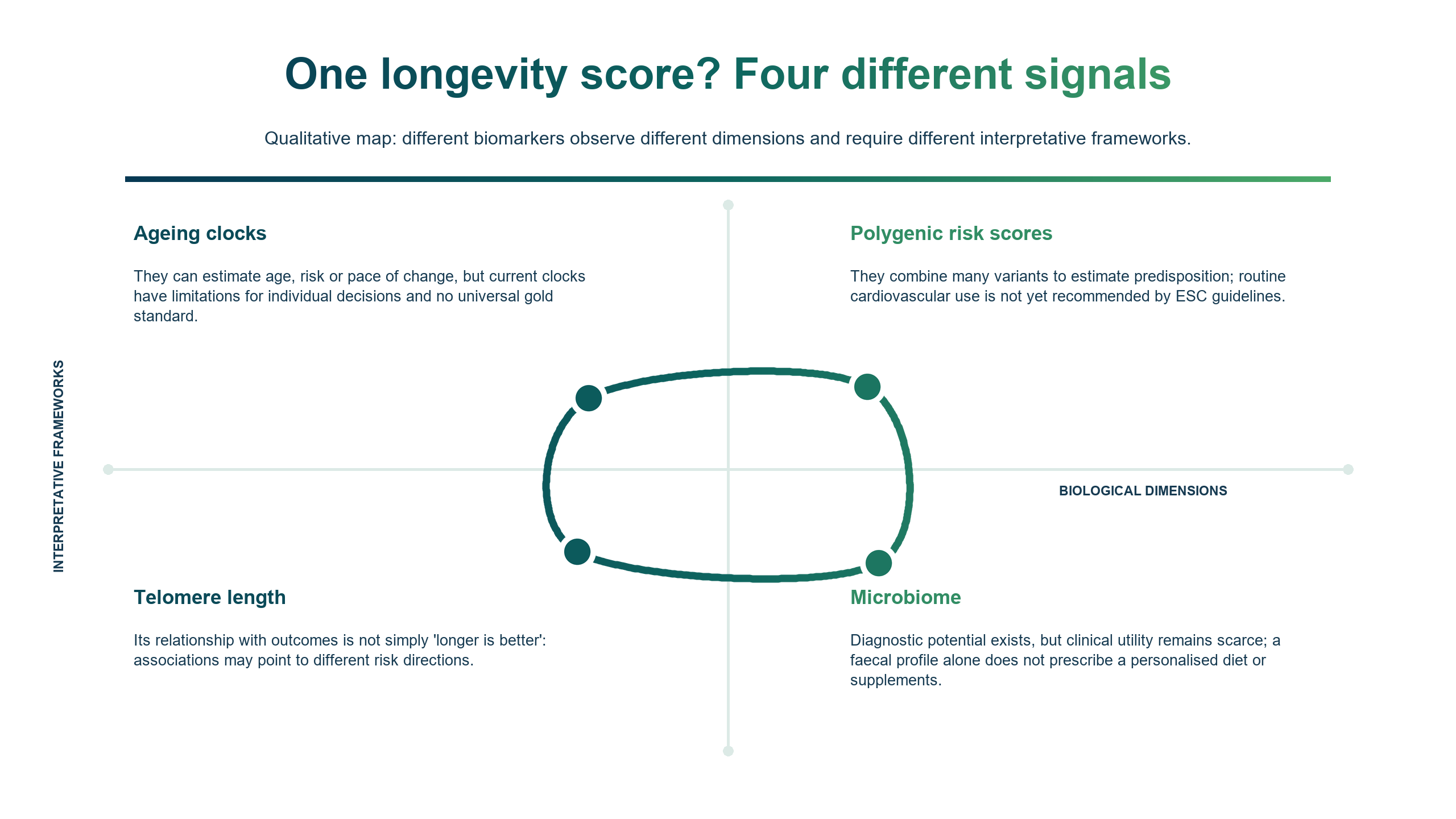
Preventive molecular diagnostics encompass technologies at very different levels of maturity. A genetic test for a high-penetrance variant in a selected family, a polygenic risk score, a telomere measurement and a commercial microbiome profile require distinct interpretative frameworks.
Polygenic risk scores combine numerous variants to estimate complex predispositions. A 2025 European clinical consensus on cardiovascular risk examines their use within defined clinical models, with attention to population, calibration and added value over traditional factors. ESC guidelines do not yet recommend their routine use, and further prospective and implementation studies are still needed [13]. Their potential therefore does not justify reducing an individual's longevity to a single genomic score.
Telomere length presents a different problem. It is associated with ageing and outcomes, but the relationship does not follow the intuitive rule that 'longer is better'. In a Mendelian randomisation study in UK Biobank, greater genetically determined telomere length was associated with a lower risk of coronary heart disease and a higher risk of cancer, with little evidence of benefit for other ageing outcomes [14]. A single number therefore conceals a balance that cannot be reduced to an age ranking.
For the microbiome, the gap between scientific interest and commercial use is particularly visible. A 2025 international consensus acknowledges its diagnostic potential, but notes that evidence of clinical utility is still scarce and that many direct-to-consumer tests are offered without proven value in practice [15]. Broad profiling by NGS and targeted quantification by qPCR answer different questions; neither can, on its own, turn the composition of a faecal sample into a personalised diet or supplement regimen. Interpretation requires an indication, controlled pre-analytics, validated assays, appropriate reference data and explicit limitations.
7. The risk of prevention that creates greater uncertainty
Among asymptomatic people, the probability of disease is often low. Even good performance can therefore generate false positives, borderline results and incidental findings, potentially leading to further tests, follow-up, anxiety and interventions. A negative result may instead provide inappropriate reassurance if the test covers only part of the risk.
The FDA notes that direct-to-consumer tests have different levels of evidence, that different companies may examine different variants and that a positive result does not mean the disease will develop. A negative result does not replace recommended prevention, and dietary or healthcare decisions should not be made without consulting a qualified professional [16]. A responsible service prepares the context before testing and supports interpretation after the result.
Within the European framework, Regulation (EU) 2017/746 links communication, performance and evaluation to the stated intended purpose. For genetic tests used in healthcare for diagnostic, therapeutic, predictive or prenatal purposes, Article 4 requires appropriate information on the nature, significance and implications of the test and, under specific conditions, access to counselling [17]. In these contexts, the report should therefore make the limitations, need for confirmation, possible consequences and interpretative responsibilities clear, in addition to the estimated risk.
8. The responsibility of a longevity clinic is part of the service
In private clinics, the service model affects quality. Subscriptions and longitudinal monitoring can promote continuity, adherence and learning, but may also encourage the repetition of measurements that generate revenue without changing a decision.
In 2026, Pagani and colleagues proposed a voluntary framework for Swiss healthy longevity clinics based on initial risk stratification, proportionate diagnostics, grading of evidence, extended consent, data security, audits and transparent outcomes [18]. It is a proposal by the authors, not an official Swiss guideline or a regulatory endorsement. Its value lies in making the responsibility with which innovation is applied observable.
To integrate a test, a clinic, laboratory or industry partner must define the need being addressed, the associated decision, the management of unexpected results and the outcomes to be observed. Commercial cadence should follow clinical cadence.
9. Distributed molecular capacity can reduce latency, not create clinical utility
In established pathways, distributed molecular capacity can reduce transport, waiting times and loss to follow-up. The benefit depends on the target, assay, population, controls, operator and predetermined consequence of the result. The instrument's location does not validate the biomarker or transform an exploratory measurement into a clinically useful test.
Distributed qPCR may be considered where there is a nucleic acid target, a workflow validated in the intended context and management consistent with the intended purpose and applicable regulatory framework. It does not provide a universal reading of ageing. In epigenetics, proteomics or the microbiome, complexity may lie in sample preparation, normalisation, the algorithm or specialist interpretation.
The time saved through distribution has value when the pathway has already been designed and monitoring is justified. Without a defined link between result and decision, uncertainty merely arrives sooner.
FAQ
Clocks built on different data and outcomes are available today. They can be useful in research and group stratification, but there is no universal gold standard, and the individual result also depends on the method, tissue, pre-analytics, population and algorithm [4,5,8–12].
Not necessarily. The change must exceed measurement noise, be replicated and be linked to clinical or functional outcomes. Some variations may be transient, and different clocks may respond differently [8–11].
Not in general. Both fields are scientifically relevant, but there is no universal clinical rule that translates those results into effective and safe supplements for an individual. An indication, evidence for the intervention, a context of use and professional supervision are required [14–17].
Analytical validity concerns the test's ability to measure accurately and reproducibly. Clinical validity describes the extent to which the signal is associated with the condition or outcome in the intended population. Clinical utility requires a further step: using the result must change management and produce a benefit proportionate to costs and risks. A test may meet the first level without meeting the other two [4–7].
The 2025 European clinical consensus describes its potential within defined models, considering population, calibration and added value over traditional factors. ESC guidelines do not yet recommend routine use, and prospective and implementation evidence is still needed [13].
For a retest to be interpretable, the expected change, time interval, minimum difference distinguishable from error and decision associated with the result must be defined. Pre-analytical conditions must also remain comparable. If these requirements are not met, the series of measurements does not in itself demonstrate a preventive benefit [8–12].
No. The number of analytes and sampling frequency do not compensate for the absence of a defined context of use. Repetition is informative only if the change exceeds measurement noise, pre-analytical conditions remain comparable and the result can change an explicit decision [4,5,8–12].
The need being addressed, intended population, decision associated with the result, test limitations, management of unexpected results and outcomes to be observed must be clarified. The pathway must also provide professional interpretation, appropriate information and a testing frequency consistent with the clinical purpose, rather than the mere availability of the measurement [4–7,16–18].
Conclusions
Molecular diagnostics enter longevity medicine when the context of use is defined and the result leads to a verifiable choice. The number of analytes, sampling frequency and a composite age are not enough to demonstrate maturity.
Ageing clocks and other omics technologies are expanding what geroscience can observe. Their translation into practice, however, requires association and causality, analytical performance and individual utility, and molecular change and functional health to remain distinguishable.
Before entering people's lives, an ageing signal must clear a higher threshold than mere measurability: it must be clear how it should be interpreted and what it will change in the pathway.
Sources
[1] World Health Organization. Ageing and health. 1 October 2025. WHO
[2] World Health Organization. Healthy ageing and functional ability. 26 October 2020. WHO
[3] Bischof E, Scheibye-Knudsen M, Siow R, Moskalev A. Longevity medicine: upskilling the physicians of tomorrow. Lancet Healthy Longev. 2021;2(4):e187–e188. Comment. DOI: 10.1016/S2666-7568(21)00024-6. DOI
[4] Moqri M, Herzog C, Poganik JR, et al. Validation of biomarkers of aging. Nat Med. 2024;30:360–372. DOI: 10.1038/s41591-023-02784-9. Publisher DOI
[5] Biomarkers of Aging Consortium; Herzog CMS, Goeminne LJE, Poganik JR, et al. Challenges and recommendations for the translation of biomarkers of aging. Nat Aging. 2024;4:1372–1383. DOI: 10.1038/s43587-024-00683-3. Publisher DOI
[6] US Food and Drug Administration. FDA Facts: Biomarkers and Surrogate Endpoints. Content current as of 21 December 2017. FDA
[7] US Food and Drug Administration. What Does Biomarker Qualification Do (And Not Do)? Transcript. Content current as of 3 March 2017. FDA
[8] Apsley AT, Etzel L, Ye Q, Shalev I. From population science to the clinic? Limits of epigenetic clocks as personal biomarkers. Epigenomics. 2025;17(18):1447–1461. Perspective. DOI: 10.1080/17501911.2025.2603880. Publisher DOI
[9] Higgins-Chen AT, Thrush KL, Wang Y, et al. A computational solution for bolstering reliability of epigenetic clocks: implications for clinical trials and longitudinal tracking. Nat Aging. 2022;2:644–661. DOI: 10.1038/s43587-022-00248-2; PMID: 37117756. PubMed DOI
[10] Poganik JR, Zhang B, Baht GS, et al. Biological age is increased by stress and restored upon recovery. Cell Metab. 2023;35:807–820.e5. DOI: 10.1016/j.cmet.2023.03.015; PMID: 37086720. PubMed DOI
[11] Bischoff-Ferrari HA, Gängler S, Wieczorek M, et al. Individual and additive effects of vitamin D, omega-3 and exercise on DNA methylation clocks of biological aging in older adults from the DO-HEALTH trial. Nat Aging. 2025;5:376–385. Letter; post hoc analysis. DOI: 10.1038/s43587-024-00793-y. Publisher DOI
[12] Herzog CMS, Poganik JR, Boekstein N, et al. Recommendations for biomarker data collection in clinical trials by longevity biotechnology companies. npj Aging. 2026;12:16. DOI: 10.1038/s41514-025-00313-1. Publisher DOI
[13] Schunkert H, Di Angelantonio E, Inouye M, et al. Clinical utility and implementation of polygenic risk scores for predicting cardiovascular disease: a clinical consensus statement. Eur Heart J. 2025;46(15):1372–1383. DOI: 10.1093/eurheartj/ehae649; PMID: 39906985. PubMed DOI
[14] Kuo CL, Pilling LC, Kuchel GA, Ferrucci L, Melzer D. Telomere length and aging-related outcomes in humans: a Mendelian randomization study in 261,000 older participants. Aging Cell. 2019;18(6):e13017. DOI: 10.1111/acel.13017; PMID: 31444995. PubMed DOI
[15] Porcari S, Mullish BH, Asnicar F, et al. International consensus statement on microbiome testing in clinical practice. Lancet Gastroenterol Hepatol. 2025;10(2):154–167. DOI: 10.1016/S2468-1253(24)00311-X; PMID: 39647502. PubMed DOI
[16] US Food and Drug Administration. Direct-to-Consumer Tests. FDA
[17] European Parliament and Council of the European Union. Regulation (EU) 2017/746 on in vitro diagnostic medical devices, in particular Articles 2, 4 and 7 and Annex XIII. EUR-Lex
[18] Pagani A, Thor D, Erat A, et al. Toward responsible longevity medicine: Swiss framework for healthy longevity medicine clinics. Longevity. Published online 21 January 2026. Proposed voluntary framework. DOI: 10.1080/30653495.2025.2583907. Publisher DOI


