
29 September 2026


Reading time [minutes]: 19


Distributed Diagnostics

Distributed PCR and preparedness: the capacity that must be in place before an emergency

A diagnostic network is ready if it can turn a new signal into a verified assay, deploy it to the right nodes and connect results to actionable decisions.


Abstract

Distributed qPCR can reduce the distance between sample, result and action during an outbreak. The presence of instruments across a region, however, does not by itself create an alert system. The agent must first be detected and characterised; the targeted assay must then be designed, verified, manufactured, distributed and updated. Meanwhile, nodes must receive informative samples, operate under quality control and return interpretable data. Diagnostic preparedness therefore depends on a hybrid network
Surveillance and reference laboratories, genomics, manufacturing capacity, regulatory processes, supply chains and data governance. The value of distribution becomes apparent when this capacity remains active between crises and is tested through exercises. Buying technology after the first alarm means arriving too late.

Snapshot

Diagnostic preparedness
The system's capacity to turn a signal into a verified method, distribute it, govern its quality and data and connect the result to actionable decisions. An inventory of instruments describes only potential capacity [3,11].

Targeted assay
qPCR becomes part of the response after the target has been characterised and the method has been designed, verified and controlled; it does not replace agnostic discovery capabilities [7,10].

Hybrid network
Reference centres and distributed nodes perform complementary functions. The former characterise, verify and update; the latter apply controlled assays and refer discordant or uninterpretable samples [6,10].

Interpandemic use
Coherent routine programmes maintain operators, quality, connectivity, referral pathways and supply chains; GISRS demonstrates the value of continuous infrastructure between emergencies [4,5].

Exercise
Readiness must be tested through site activation, controls, invalid results, stock availability, intermittent connectivity and time to decision, with corrective criteria defined before operational pressure arises [9,11].

Introduction

A distributed qPCR network operates mainly in the final part of the chain, after the signal has been recognised and the target defined. It can shorten transport, queuing and result delivery, but does not replace discovery, reference laboratories, assay design and verification, manufacturing, regulatory processes, supply chains, data and decision criteria. Preparedness is therefore a property of the connections between these functions, not of the individual instrument.

This Insight examines what must be in place before an emergency: interpandemic use that maintains skills and quality, a network topology with referral and escalation pathways, a verified route from assay to deployment, managed stocks, interoperability and exercises. The aim is to distinguish installed capacity from demonstrated readiness, so that expansion during a crisis starts from a system that is already operational, rather than from a promise to be built under pressure.

1. The limits of diagnostic prevention

Spillover may go unnoticed; the alarm may come from a clinically unusual cluster or an environmental signal. A qPCR network cannot prevent that transition and, until a target and an assay exist, it cannot identify the agent agnostically. If integrated with the other necessary capabilities, however, it can shorten the path between an informative signal, confirmation, monitoring and a proportionate response.

For this reason, the term prevention requires precision. Diagnostics work alongside epidemiological surveillance, biosafety, infection control, vaccines, treatments and community trust; they do not replace them. Their contribution is measured at the point when a result reaches a decision that is still open. This Insight focuses on pre-deployment capacity: the roles, methods, quality, manufacturing, data and decision criteria that must be prepared before operational pressure begins.

In 2025, WHO Member States adopted the Pandemic Agreement. As of August 2026, the Agreement is not yet in force: the annex on Pathogen Access and Benefit-Sharing must be completed and adopted, after which the text can be opened for signature and ratification; entry into force will require 60 ratifications [1]. The 2024 amendments to the International Health Regulations, by contrast, entered into force on 19 September 2025 for 185 of the 196 States Parties and introduce, among other provisions, the category of pandemic emergency and National IHR Authorities [2].

These frameworks assign responsibilities and coordination, but do not establish diagnostic capacity. A WHO framework published in March 2026 defines twelve core capabilities for national public health agencies, grouping foundational and technical functions: authority, flexible funding, evidence generation, surveillance, laboratory and diagnostic systems, workforce, coordination and access to countermeasures [3]. Readiness is therefore a property of the system, not of a single technology.

2. The timelines a network must shorten

During an emergency, test turnaround is only one of the clocks involved. Before it come the time from the first event to an informative sample and the time needed to characterise the agent. These are followed by the transition from sequence to primer, probe and control design, verification, manufacturing, release and deployment. The final interval, often decisive, separates the result from action.

Distributed qPCR can influence the final part of this chain: sample transport, laboratory queuing, result delivery and, if the pathway is already in place, time to decision. Before the target is known and the assay available, peripheral devices do not recognise the pathogen agnostically. Clinical and epidemiological observation, culture, metagenomics, sequencing and reference laboratories are needed. Once the target has been defined, targeted PCR can scale up a discovery made in a specialist setting.

The centre and local nodes therefore perform different functions within the same circuit. The centre identifies and characterises the agent, compares signals and updates methods. Nodes apply verified assays across larger volumes and wider geographies; unusual, discordant or uninterpretable samples are referred to the centre. Technology moves in both directions, alongside data, controls and escalation criteria.

3. Routine infrastructure is the emergency reserve

Capacity that exists only on paper deteriorates quickly: operators lose familiarity, consumables expire, software changes, connections remain untested and supply contracts unverified. Keeping an emergency network ready therefore requires coherent interpandemic activity. This may involve respiratory surveillance, zoonoses, endemic diseases, antimicrobial resistance, food safety or other defined programmes, provided that methods and purposes are documented.

The Global Influenza Surveillance and Response System is an example of infrastructure that does not wait for a pandemic. Active since 1952, it comprises 166 institutions in 136 Member States and operates continuously for surveillance, preparedness and response to seasonal, pandemic and zoonotic influenza [4]. In 2025, WHO published guidance to further integrate SARS-CoV-2 and RSV into influenza sentinel surveillance [5].

GISRS does not provide a model to be copied as a network of thousands of identical instruments; it demonstrates the value of continuity. For a diagnostic network, this means maintaining protocols, relationships, external quality assessment, referral pathways, data sharing and the capacity to update long before they have to function under pressure. Routine use makes essential components of the emergency plan workable and reveals their weaknesses in time.

4. Where to locate different capabilities

Distribution does not mean testing everything everywhere. The network assigns different capabilities to the points where they can generate information or support a decision. Sentinel sites observe trends in defined samples and populations; clinical nodes address urgent questions; mobile laboratories provide surge capacity. Reference centres retain responsibility for discordant results, sequencing, verification and method updates.

The 2025 WHO standards for Rapid Response Mobile Laboratories require coordinated, interoperable, high-quality, safe, scalable and predictable capabilities [6]. Mobility is therefore a way to distribute capacity, not an exemption from requirements. A mobile laboratory that is not integrated with sample identification, biosafety, waste management, controls, data and referral pathways can also move error rapidly.

Risk and purpose guide site selection: travel flows, density, vulnerability, human–animal interfaces, healthcare capacity, distance and the populations being observed. Design also includes sampling. A dashboard can receive many results from the same population and still fail to see excluded groups; without denominators and stable criteria, an increase in testing primarily measures diagnostic activity, not necessarily the information available.

5. From reference assay to deployment

Part of technical preparedness can be built before the specific pathogen is known. Target libraries for viral families, synthetic materials, extraction protocols, panels of interfering substances, regulatory templates and agreements between laboratories reduce the work that has to be invented during a crisis. When the pathogen emerges, verification of the agent, matrix, population and actual workflow configuration is nevertheless still necessary.

When a sequence becomes available, design must consider inclusivity, cross-reactivity and regions prone to mutation. This is followed by the limit of detection, precision, robustness, controls, appropriate clinical or surrogate samples and comparisons between sites. MIQE 2.0 sets out recommendations for sample handling, assay design, analytical validation, analysis and qPCR reporting [7]. It improves transparency and reproducibility; by itself, it does not constitute regulatory authorisation, clinical validation or evidence that an assay can be transferred to a network.

The WHO Emergency Use Listing is a temporary, risk-based procedure for assessing unauthorised products in emergency settings when data are still limited. It is not equivalent to WHO prequalification and does not replace national authorities' decisions on product use [8]. An emergency may therefore make a greater degree of uncertainty acceptable within a defined pathway; it does not make uncertainty invisible or remove change control, monitoring and responsibility.

6. The supply chain is part of performance

Instruments are the visible part of a much longer chain. To operate, nodes need swabs, containers, reagents, enzymes, oligonucleotides, controls, plastics, protective equipment, labels, transport and waste-management materials. If a common component is missing, the network can stop at many points simultaneously while the instruments remain fully available.

A reserve must be described in terms of lead times, alternative suppliers, capacity per shift, quality-release times, shelf life, storage conditions and allocation rules; the number of items alone says little. Stabilised reagents, too, simplify logistics only within documented limits for temperature, humidity, packaging and conditions after opening. The ambient stability of one component does not automatically extend to the entire workflow.

A WHO exercise addressing a potential influenza A(H5N1) scenario, published in January 2026, examined access to, allocation and deployment of vaccines, antivirals and diagnostics. The report highlights the interdependence of surveillance, regulatory pathways, manufacturing, supply chains, funding and national readiness [9]. Manufacturing and distribution capacity must therefore be part of assay and network design, rather than treated as a separate phase to be activated after the science.

7. When a result becomes a network signal

To be interpreted alongside other results, a local result must retain its context: identifier, time, location, matrix, method, assay version, controls, outcome, denominator and sampling criteria. A count of positive results alone cannot distinguish increased transmission from increased diagnostic activity if we do not know who was tested and how access and criteria have changed.

Connectivity must also be designed for times when the network is absent or unstable. Offline operation, synchronisation, duplicate prevention, audit, correction and version traceability are needed. A dashboard is only the interface: interoperability means preserving the meaning of data as they pass through systems and levels of governance. Privacy, data minimisation and access control remain necessary during an emergency.

In 2025, the International Pathogen Surveillance Network established three communities of practice dedicated to the use of genomic data in public health decisions, emergency response, and environmental and wastewater surveillance [10]. For distributed qPCR, the implication is bidirectional: nodes send signals and receive updates on targets, variants, criteria, priorities and escalation needs.

8. Measuring readiness before an outbreak

A plan that has never been tested retains assumptions that appear to be capabilities. An exercise must expose them: a new target, a failed batch, intermittent connectivity, rising volumes, a shortage of a consumable. The operational test covers the entire pathway: who activates sites, who authorises the assay, how controls arrive, where discordant samples are sent and how long the first valid result takes to reach a decision.

Useful metrics include sites operational within the planned window, competent operators, the invalid-result rate, inter-laboratory concordance, consumable availability, method-update time, data completeness and time between signal and action. The WHO PRET framework assesses integrated functional capacities — coordination, collaborative surveillance, community protection, clinical care and access to countermeasures — rather than the inventory alone [11].

Testing frequency and reporting speed can be decisive in a surveillance programme. A model developed for SARS-CoV-2 screening showed that, in that scenario, frequency and turnaround mattered more than moderate variations in analytical sensitivity [12]. This is a bounded design lesson, not a rule transferable to clinical diagnosis or other pathogens: prevalence, purpose, the infectious window and the consequences of false results change the trade-off.
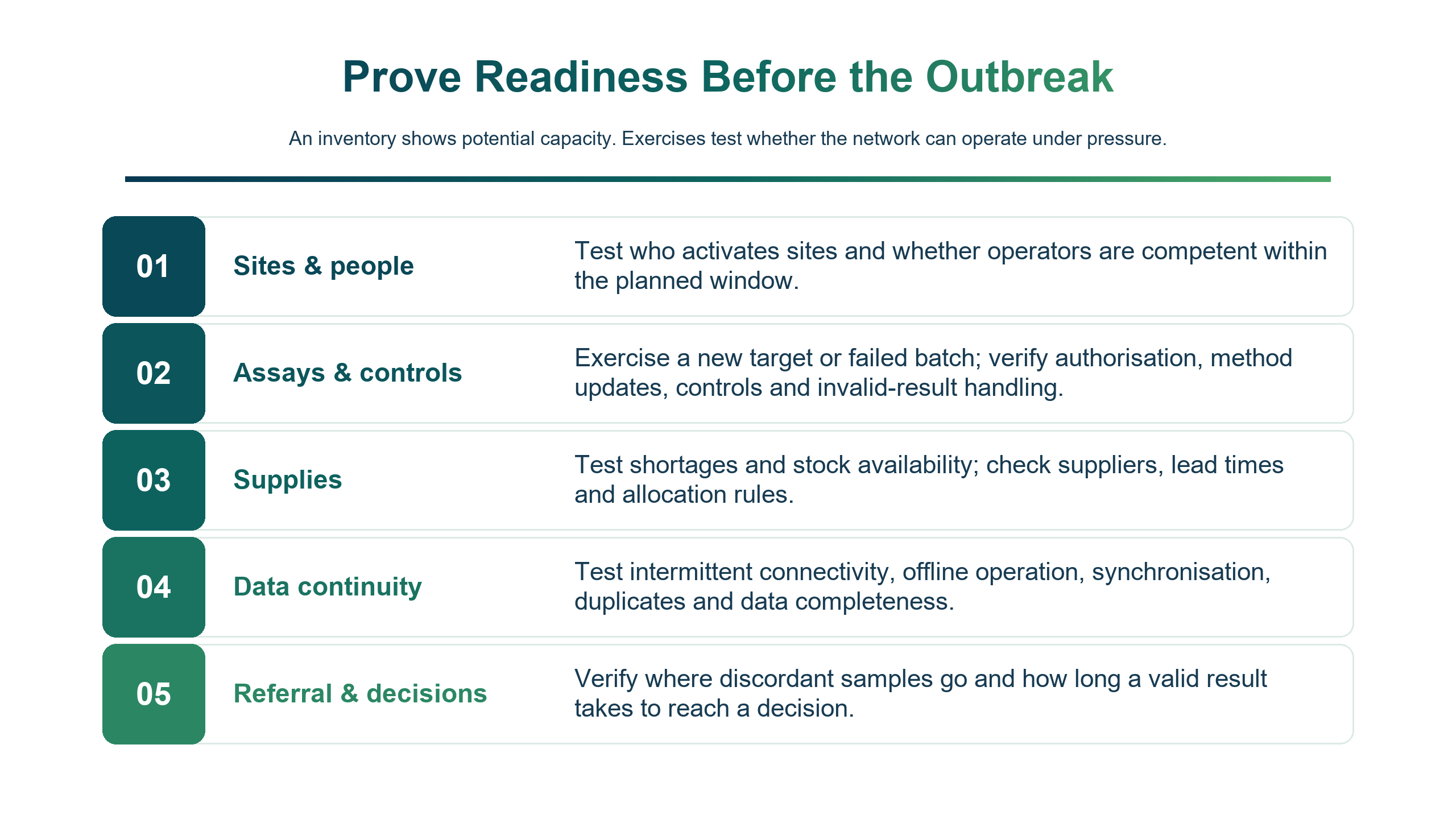
Five readiness checks before an outbreak: sites and people, assays and controls, supplies, data continuity, and referral and decisions. Exercises test network operation; the inventory indicates only potential capacity.

9. What makes a network equitable

Collecting samples for a wider system is not enough if knowledge, referral support and access do not return to the node. Diagnostic equity requires communities to receive timely results and have a pathway capable of translating them into protection or care. For this reason, training, maintenance and local analytical capacity carry the same weight as the ability to send samples or sequences.

Distribution can shorten distances and delays, but can also create unequal standards between sites if quality and funding are not sustained over time. The strongest model combines common benchmarks with operational autonomy: shared performance criteria verified under realistic conditions, together with local capacity to interpret and use the data.

FAQ

Do more qPCR instruments across a region automatically mean earlier alerts?

No. Informative sampling, available and appropriate assays, quality, denominators, interoperable data and decision triggers are needed. The number of devices describes potential capacity, not an outcome.

Can qPCR recognise a completely unknown pathogen?

Targeted PCR requires a target. Discovery techniques and reference laboratories must first characterise the agent; qPCR can then distribute and scale up a specific search across the network.

Should platforms remain idle until an emergency?

No. Coherent routine use helps maintain operators, supply chains, quality and connectivity. Each application must, however, comply with its intended purpose, assay, matrix and documented conditions; interpandemic use does not authorise unvalidated extensions.

Is a WHO Emergency Use Listing equivalent to definitive authorisation?

No. It is a temporary, risk-based assessment for an emergency setting, not prequalification, and it does not replace national authorities' decisions. Monitoring, change management and the collection of further data remain necessary [8].

When should a result be referred to the reference centre?

When it is unusual, discordant or uninterpretable, or requires confirmation, sequencing or a method update. The escalation criterion must be defined before deployment and include responsibilities, sample traceability and the return of the outcome to the node.

What must an exercise demonstrate before an outbreak?

It must verify, against planned criteria, site activation, the assay authorisation and update pathway, control distribution, management of invalid and discordant results and the time from the first valid result to a decision. The value of the exercise also lies in the gaps it makes possible to correct before operational pressure arises.

Conclusions

Distributed qPCR contributes to preparedness if it becomes part of a network that is already active. After the target and method have been defined, it can shorten distances and turnaround times; the response, however, depends on connections with discovery, reference laboratories, assay verification, manufacturing, regulatory processes, data, stocks, referral pathways and decisions. If one of these steps is missing, distribution remains nominal capacity.

The most useful test takes place away from an emergency. An exercise reveals a control that fails to arrive, an operator who is not yet authorised or data that do not synchronise, while there is still time to correct the system. The strategic reserve then consists of a network that maintains skills, checks dependencies and continues to learn even when the emergency is no longer front-page news; the stock of instruments is only one component.


Sources and Bibliography

[1] World Health Organization. WHO Pandemic Agreement. Accessed 12 August 2026. https://www.who.int/health-topics/who-pandemic-agreement

[2] World Health Organization. Amended International Health Regulations enter into force. 19 September 2025. https://www.who.int/news/item/19-09-2025-amended-international-health-regulations-enter-into-force

[3] World Health Organization. Framework for health emergency preparedness and response capabilities for national public health agencies. 23 March 2026. WHO reference B09726. https://www.who.int/publications/i/item/B09726

[4] World Health Organization. Global Influenza Surveillance and Response System (GISRS). Accessed 12 August 2026. https://www.who.int/initiatives/global-influenza-surveillance-and-response-system

[5] World Health Organization. Expanding the Global Influenza Surveillance and Response System to include other respiratory viruses with epidemic or pandemic potential. 25 March 2025. https://www.who.int/news/item/25-03-2025-expanding-the-global-influenza-surveillance-and-response-system-to-include-other-respiratory-viruses-with-epidemic-or-pandemic-potential

[6] World Health Organization. Minimum operational standards and typology for rapid response mobile laboratories. 28 April 2025. ISBN: 978-92-4-010711-3. https://www.who.int/publications/i/item/9789240107113

[7] Bustin SA, Ruijter JM, Van den Hoff MJB, et al. MIQE 2.0: Revision of the Minimum Information for Publication of Quantitative Real-Time PCR Experiments Guidelines. Clinical Chemistry. 2025;71:634-651. https://doi.org/10.1093/clinchem/hvaf043

[8] World Health Organization. Emergency Use Listing Procedure. Accessed 12 August 2026. https://extranet.who.int/prequal/medicines/emergency-use-listing-procedure

[9] World Health Organization. Simulation exercise for influenza A(H5N1) response on access, allocation, and deployment of medical countermeasures: meeting report, Geneva, Switzerland, 4-5 September 2025. 20 January 2026. WHO reference B09685. https://www.who.int/publications/i/item/B09685

[10] World Health Organization. WHO establishes communities of practice for pathogen genomics surveillance. 11 July 2025. https://www.who.int/news/item/11-07-2025-who-establishes-communities-of-practice-for-pathogen-genomics-surveillance

[11] World Health Organization. A framework for tracking global progress on preparedness for respiratory pandemics. 21 February 2025. ISBN: 978-92-4-009424-6. https://www.who.int/publications/i/item/9789240094246

[12] Larremore DB, Wilder B, Lester E, et al. Test sensitivity is secondary to frequency and turnaround time for COVID-19 screening. Science Advances. 2021;7:eabd5393. https://doi.org/10.1126/sciadv.abd5393