
20 October 2026


Reading time [minutes]: 19


Microbiota, Diagnostics and Nutraceuticals

Microbiota: from research to diagnostic validation

How NGS profiling, targeted qPCR and bioinformatics contribute at different stages of the translation of microbial signals, and what evidence is needed for a signal to become a clinically usable test.


Abstract

Context
The microbiota is associated with numerous physiological and pathological conditions, but a reproducible association is not the same as a diagnostic test. Translation into clinical practice requires a defined method, a specific intended use and adequate analytical and clinical evidence.

Evidence
Sequencing-based profiling enables the exploration of microbial communities and potential functions; qPCR measures preselected targets through a targeted assay; bioinformatics determines a substantial part of the result in both cases. Pre-analytical standardisation, controls, appropriate statistics and external validation remain the main bottlenecks. The signatures studied in colorectal cancer and inflammatory bowel disease are promising, but do not in themselves demonstrate clinical utility or widespread routine use.

Implications
Diagnostic value emerges when discovery, assay design, analytical and clinical performance, utility and regulatory requirements form a coherent chain. Along this pathway, NGS and qPCR are not interchangeable alternatives, but tools for different stages of translation.

Snapshot

Profiling and targeted testing
Microbiome profiling describes a community; a qPCR panel measures preselected targets and does not replace a comprehensive representation of the ecosystem [1,2].

Intended purpose
A signal becomes a diagnostic candidate only when the population, sample matrix, comparator, threshold, users and supported decision are defined and supported by analytical and clinical evidence [3,5,6].

Reproducibility
Sampling, storage, extraction, platform, database and bioinformatics pipeline are part of the result; controls and reference materials must span the entire workflow [7,9-12].

Compositional data
Relative abundances alone do not reveal the direction and magnitude of changes; microbial load can alter associations and interpretation [13,14].

Validation chain
Association, replicated signature, targeted assay, clinical performance, utility and implementation are distinct gates; none can be skipped when transferring a research result into routine practice [3,5,6,15-18].

Introduction

Microbiota research is producing a growing number of associations with diseases, treatment responses and phenotypes. The difficulty lies not in observing a signal, but in establishing whether that signal is specific, reproducible and able to add information beyond the tools already available.

This Insight traces the pathway that separates profiling from diagnostics. It distinguishes the roles of NGS, targeted qPCR and bioinformatics and examines which steps - standardisation, external validation, clinical performance, utility and intended purpose - must be completed before a microbial signature can support a clinically and regulatorily defensible test.

1. Microbiota, microbiome and testing: three concepts to distinguish

The microbiota is the collection of microorganisms present in a defined environment; the microbiome also encompasses their genomes, functions and the ecological context in which they operate. A test, by contrast, is a measurement procedure designed to answer a specific question. The distinction is substantive: describing a microbial community does not automatically mean diagnosing a disease, predicting its course or indicating a treatment [1].

In everyday language, ‘microbiome testing’ is sometimes used to describe very different activities: 16S sequencing, shotgun metagenomics, quantification of individual microorganisms, targeted molecular panels or proprietary ‘dysbiosis’ indices. The international consensus published in 2025 proposes a useful distinction: community profiling requires methods capable of representing its composition, whereas a PCR panel that detects selected targets answers a narrower question and does not replace comprehensive profiling [2].

The operational consequence is straightforward. Before choosing a technology, it is necessary to define what is to be measured, in which population, with which sample, against which comparator and for which decision. Without this framework, even a technically accurate result may lack clinical meaning.

2. Many associations, few clinically usable tests

The literature describes thousands of associations between microbial characteristics and human phenotypes. Only a proportion, however, remain robust across cohorts, geographical areas, diets, medications, ages, comorbidities and laboratory procedures. A multidisciplinary consensus on microbiome-based biomarkers identified the shortage of validated analytical methods and procedures that are straightforward to interpret as key obstacles to clinical qualification [3].

The problem is not solely statistical. A signal may be real but insufficiently specific; it may reflect a consequence of disease rather than precede it; or it may add little information beyond the tests already available. To become a biomarker, a signature must be replicated in independent populations, measured through a controlled process and translated into an interpretative rule consistent with its intended use.

Caution is particularly important in direct-to-consumer services. In 2026, an evaluation using standardised faecal material developed by the National Institute of Standards and Technology found substantial discrepancies between and, in some cases, within seven commercial services. Methodological variability was of the same order of magnitude as biological variability between donors, with consequences for the health interpretations returned to users [4]. This does not refute microbiome science; it demonstrates that analytical validity must precede any clinical or behavioural advice.

3. From discovery to testing: the maturity chain

Diagnostic translation can be understood as a sequence of steps, each with its own question:

Association → discovery → replicated signature → targeted assay → clinical performance → utility → implementation.

Discovery identifies communities, genes or functions associated with a phenotype. The next stage assesses whether the signature persists in independent cohorts and after controlling for the main confounders. Only then is it reasonable to select a smaller set of targets and develop an assay that can measure them robustly. This is followed by defining thresholds, evaluating sensitivity and specificity in the intended population, comparing performance with the standard of care and assessing the impact on clinical decision-making.

The final step is not a purely technical act. Within the European framework, an in vitro diagnostic medical device must have a defined intended purpose and adequate clinical evidence. Regulation (EU) 2017/746 and the MDCG guidance distinguish the scientific validity of the analyte, analytical performance and clinical performance: these components are connected, but are not equivalent [5,6]. A published signature may therefore provide a research basis without yet being a test that can be used for patients.

This chain also helps to avoid two common shortcuts: turning correlation into causation and automatically transferring the performance of a computational model to the assay intended to measure it in practice. Any change in sample matrix, platform, protocol or population may alter the result and requires verification proportionate to the intended use.
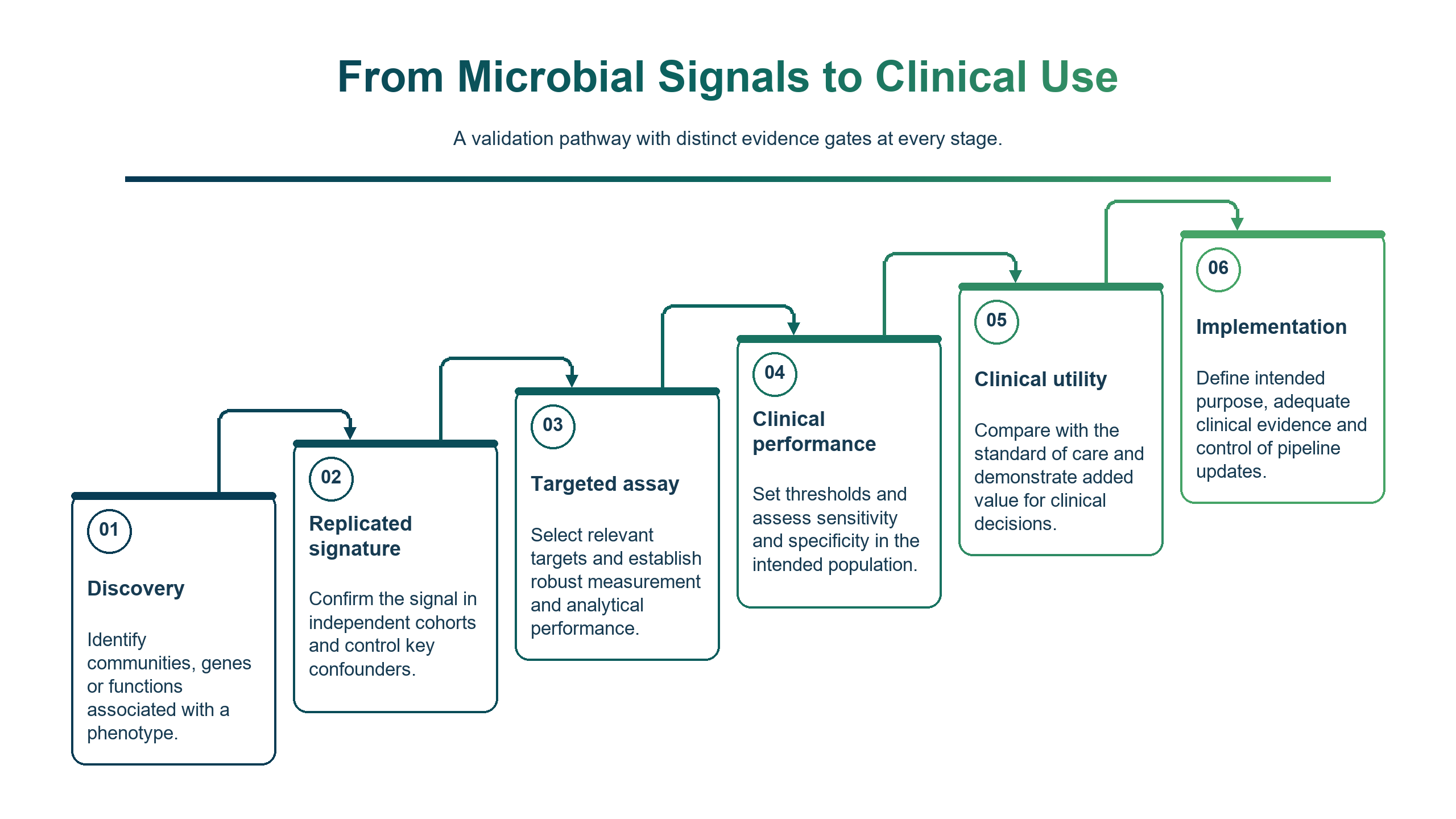
Six steps from microbial signal to clinical use: discovery, replicated signature, targeted assay, clinical performance, utility and implementation, each supported by specific evidence.

4. NGS, qPCR and bioinformatics: different roles

Next-generation sequencing is particularly suited to discovery. 16S sequencing enables broad characterisation of the bacterial component, with resolution depending on the amplified region and the pipeline. Shotgun metagenomics can extend the analysis to species, strains, genes and functional potential, but requires greater analytical depth, contaminant control and computational capacity. In both cases, the result is a community profile, not an automatic clinical interpretation [2,7].

qPCR operates within a different scope: it measures sequences already selected through defined primers, probes and controls. It can be useful when discovery has narrowed the field to relevant targets and when a signature needs to be translated into a more focused assay. Its advantage derives not from universal superiority, but from the fit between targets, sample matrix, required performance and workflow. The MIQE 2.0 guidelines emphasise that design, efficiency, controls, normalisation and transparent reporting determine the reliability of every quantitative experiment [8].

Bioinformatics is not an accessory placed ‘after’ the laboratory. Database selection, filtering, taxonomic assignment, contaminant handling, statistical transformations and software version can change the output. A pipeline intended to support a biomarker must therefore be defined, versioned, verifiable and subject to change control. NGS, qPCR and bioinformatics become complementary when they are not forced into the same role: exploration, measurement and interpretation are functions with distinct requirements [7,9].
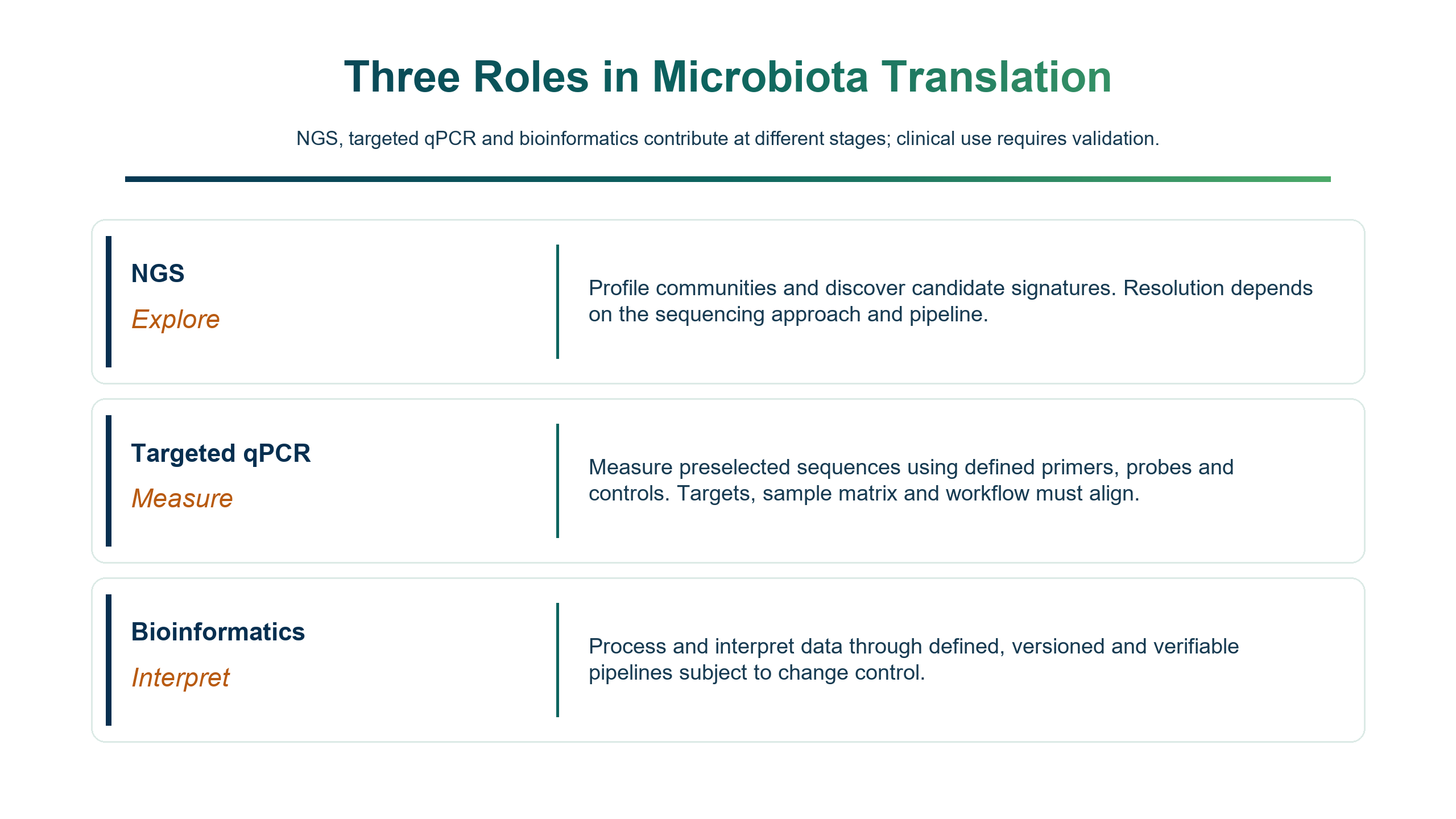
Three complementary roles in microbiota translation: NGS explores communities, targeted qPCR measures selected targets and bioinformatics interprets data through controlled pipelines.

5. Reproducibility: the real bottleneck

A microbiome-based result is the product of an entire measurement chain. Collection, container, time before stabilisation, temperature, extraction, lysis, reagent batch, positive and negative controls, sequencing depth and analytical pipeline can introduce variation. The STORMS guidelines and interlaboratory standardisation projects show why documenting these steps is essential for comparing studies and replicating results [7,9–11].

The pre-analytical phase is often decisive. Different storage or extraction protocols may favour different microbial groups; in low-biomass samples, the contaminant signal can become comparable to the biological signal. A translational project therefore requires more than a statement of the platform: it needs sampling specifications, acceptance criteria, process controls and reference materials [11,12].

The nature of the data also calls for caution. Many sequencing profiles express relative abundances: if one population increases, the others may appear to decrease while remaining stable in absolute terms. The data are compositional and must be analysed using methods compatible with this property [13]. Incorporating microbial load can change the interpretation of associations and reveal variations that a relative profile alone conceals [14].

Finally, reproducibility is not the same as clinical accuracy. A process may return the same index with great precision, yet the index may lack validated meaning. Firmicutes/Bacteroidetes ratios, universal ‘healthy microbiota’ ranges and proprietary dysbiosis scores should therefore not be treated as diagnostic shortcuts without robust, context-specific evidence [2–4].

6. Where translation is more advanced

Colorectal cancer is one of the most extensively studied fields. Multicentre metagenomic analyses have identified recurring signatures, but have also highlighted how intestinal transit, inflammation, body mass index and the definition of controls can alter apparent targets [15]. A 2025 analysis of 3,741 faecal metagenomes from 18 cohorts strengthened the reproducibility of certain signals and strain-level resolution. The result supports the development and evaluation of screening strategies, but does not in itself demonstrate clinical utility, regulatory availability or universal routine adoption [16].

In inflammatory bowel disease, a 2024 study followed a particularly instructive translational pathway: metagenomic discovery across multiple cohorts and ethnicities, species selection, then development of a multiplex ddPCR panel. The reported performance and external validation support the potential of a multibacterial approach, but do not in themselves establish clinical utility, regulatory status or adoption in routine practice [17].

Finally, targeted molecular tests for bacterial vaginosis provide a useful boundary case. The CDC guidelines describe NAATs that can be used in symptomatic women, with performance and limitations defined for specific products and settings [18]. These tests detect established combinations of microorganisms in a specific clinical context; they do not provide general profiling of the vaginal microbiome. Their maturity depends precisely on the restriction of the intended use, not on the breadth of the analysis.

7. When a result becomes clinically usable

A result becomes usable when it reproducibly answers a clinical question that changes, or can reasonably support, a decision. At a minimum, this requires: a defined population and sample matrix; a controlled pre-analytical procedure; locked targets and algorithm; documented analytical performance; thresholds established before validation; clinical performance in independent cohorts; comparison with the standard of care and alternatives; comprehensible reporting; and management of uncertain results and pipeline updates [5,6].

Clinical utility requires a further step: demonstrating that the added information improves the care pathway compared with what is already available. A high AUC in a research cohort alone does not measure patient benefit, workflow sustainability or transferability between laboratories. This is where collaboration between microbiologists, clinicians, bioinformaticians, biostatisticians, quality specialists and regulatory experts becomes part of the method, rather than a subsequent activity [6].

8. Helyx’s potential contribution

The corporate pages of Helyx Industries S.p.A. describe capabilities positioned at different stages of this pathway. Mytho operates in customised NGS and bioinformatics pipelines, a scope consistent with highly complex discovery and characterisation projects. Hyris develops Hyris System™ for distributed qPCR workflows; any microbiota-related project would still require defined targets and assay, an explicit context of use and proportionate validation. Vytro operates in clinical PCR and IVD solutions where applicable and according to the specific intended use [19].

This map of capabilities does not demonstrate the existence of an already validated Helyx microbiota test, nor does it make the transition from an NGS signature to a clinical panel automatic. It indicates which capabilities can contribute to distinct projects: discovery, bioinformatics, assay design, manufacturing, quality, validation and implementation. Any value arising from complementarity must be demonstrated project by project, keeping research, development, clinical use and regulatory status separate.

FAQ

Is a microbiota association equivalent to a diagnostic test?

No. It may be biologically real yet insufficiently specific, replicable or informative to support a clinical decision [1-3].

Can qPCR profile the entire microbiome?

No. qPCR measures targets already selected through defined primers, probes and controls; anything not included in the panel remains outside its scope of observation [2,8].

What separates a research signature from a usable test?

An explicit intended purpose, a controlled procedure, locked thresholds, analytical and clinical performance, independent validation, comparison with the standard of care and management of updates [5,6].

Why can the same sample yield different results?

Collection, storage, extraction, sequenced region, database and bioinformatics pipeline can change the profile; comparability and reproducibility must therefore be built into the entire chain [4,7,9-12].

Does a high AUC demonstrate clinical utility?

No. It describes discriminative ability in the setting studied, but does not in itself demonstrate patient benefit, transferability between laboratories or improvement over the available tests [6,15-17].

What contribution can Helyx offer?

The divisions cover different capabilities - NGS and bioinformatics at Mytho, distributed qPCR at Hyris, clinical PCR and IVD at Vytro - but this complementarity does not demonstrate the existence of an already validated Helyx microbiota test. Each project requires its own targets, intended purpose and evidence [19].

Conclusions

Diagnostic translation of microbiota signals depends not on the quantity of observable associations, but on the quality of the pathway that turns them into reliable measurements and useful decisions. NGS, qPCR and bioinformatics contribute at different stages; no technology replaces validation.

The most promising pathways share concrete elements: replicated signatures, targeted assays, independent cohorts and explicit interpretative rules. Until these elements are connected, the result remains research. Once they are, the pathway towards a clinically and regulatorily defensible test can begin.


Sources and Bibliography

[1] Berg G, Rybakova D, Fischer D, et al. Microbiome definition re-visited: old concepts and new challenges. Microbiome. 2020;8:103. DOI

[2] Porcari S, Mullish BH, Asnicar F, et al. International consensus statement on microbiome testing in clinical practice. Lancet Gastroenterol Hepatol. 2025;10(2):154–167. DOI PubMed

[3] Rodriguez J, Hassani Z, Alves Costa Silva C, et al. State of the art and the future of microbiome-based biomarkers: a multidisciplinary Delphi consensus. Lancet Microbe. 2025;6(2):100948. DOI PubMed

[4] Servetas SL, Gierz KS, Hoffmann D, Ravel J, Jackson SA. Evaluating the analytical performance of direct-to-consumer gut microbiome testing services. Commun Biol. 2026;9:269. DOI

[5] European Parliament and Council of the European Union. Regulation (EU) 2017/746 on in vitro diagnostic medical devices. EUR-Lex

[6] Medical Device Coordination Group. MDCG 2022-2: Guidance on general principles of clinical evidence for In Vitro Diagnostic medical devices (IVDs). European Commission, 2022. European Commission

[7] Roume H, Mondot S, Saliou A, Le Fresne-Languille S, Doré J. Multicenter evaluation of gut microbiome profiling by next-generation sequencing reveals major biases in partial-length metabarcoding approach. Sci Rep. 2023;13:22593. DOI

[8] Bustin SA, Ruijter JM, van den Hoff MJB, et al. MIQE 2.0: Revision of the Minimum Information for Publication of Quantitative Real-Time PCR Experiments Guidelines. Clin Chem. 2025;71(6):634–651. DOI PubMed

[9] Mirzayi C, Renson A, Genomic Standards Consortium, et al. Reporting guidelines for human microbiome research: the STORMS checklist. Nat Med. 2021;27:1885–1892. DOI

[10] Sinha R, Abu-Ali G, Vogtmann E, et al. Assessment of variation in microbial community amplicon sequencing by the Microbiome Quality Control project consortium. Nat Biotechnol. 2017;35:1077–1086. DOI

[11] Costea PI, Zeller G, Sunagawa S, et al. Towards standards for human fecal sample processing in metagenomic studies. Nat Biotechnol. 2017;35:1069–1076. DOI

[12] Fierer N, Leung PM, Lappan R, et al. Guidelines for preventing and reporting contamination in low-biomass microbiome studies. Nat Microbiol. 2025;10:1570–1580. DOI PubMed

[13] Gloor GB, Macklaim JM, Pawlowsky-Glahn V, Egozcue JJ. Microbiome datasets are compositional: and this is not optional. Front Microbiol. 2017;8:2224. DOI

[14] Vandeputte D, Kathagen G, D’hoe K, et al. Quantitative microbiome profiling links gut community variation to microbial load. Nature. 2017;551:507–511. DOI

[15] Tito RY, Cypers H, Joossens M, et al. Microbiome confounders and quantitative profiling challenge predicted microbial targets in colorectal cancer development. Nat Med. 2024;30:1339–1348. DOI

[16] Piccinno G, Thompson KN, Manghi P, et al. Pooled analysis of 3,741 stool metagenomes from 18 cohorts for cross-stage and strain-level reproducible microbial biomarkers of colorectal cancer. Nat Med. 2025;31:2416–2429. DOI PubMed

[17] Zheng J, Sun Q, Zhang M, et al. Noninvasive, microbiome-based diagnosis of inflammatory bowel disease. Nat Med. 2024;30:3555–3567. DOI

[18] Centers for Disease Control and Prevention. Bacterial Vaginosis – STI Treatment Guidelines. CDC

[19] Helyx Industries S.p.A. Official corporate pages: three-division structure and Hyris, Vytro and Mytho pages. Accessed on 18 September 2026. Structure · Hyris · Vytro · Mytho